- Course Description
- Incident Management
- Leadership
- Expedition Skills
- Method of Instruction
- Navigation
In 2027 SEAK Expeditions along, with Sitka Wild Coast Kayaks, will be hosting the 2027 ISKGA guide program, which is a 16 day course designed to develop and enhance core skills of the commercial sea kayak guide or individual who take leadership roles in their paddling groups. The course is made up of 7 modules. The ISKGA Guide Training Course can be taken as a whole 16 day course or can also be attended in individual modules for those who do not have the time or who may have a strong interest in one particular module
Module: Incident management: The ISKGA Incident Management course is a 2 day course. This can be logged as a stand alone two day course with two bolt on modules or alternatively can be run over a 2 day period.
Module guidelines
Mind set – Pro-active/passive – Casualty or Victim
Effective identification in the difference between a paddler whom is pro-active with regards to his safety or a paddler who is passive/in-active with regards to his own safety and to be able to assess quickly these actions during an incident in dynamic conditions.
Adrenalin – To fully understand the effects of ‘Adrenal fix’ and how to control these negative/positive influences on the group
Pre fight, in fight and post fight effects of adrenalin should be understood. Trainer should be able to highlight the areas where these influences occur and to highlight the signs, symptoms and actions required to recognise and deal with adrenal overload.
SAFER – Stop, Assess, Formulate, Execute, Review. To be able to show a working knowledge of the SAFER process.
Candidates should show a logical thought process during an incident not rushing in and instead assessing the situation formulating a plan then executing that plan and reviewing the outcomes.
Lost person protocols – Methods of dealing with a lost person from your group.
Have an understanding of effective protocols for dealing with a lost person whilst on an expedition or during a day/night paddle. Standard Operating Procedures for the lost person protocol. Meeting points, communication, search patterns, engagement of outside agencies.
First Aid –
Have a wider knowledge of how to apply first aid to an incident until responsibility of an incident is handed over to an outside agency.
Outside agencies – Methods of raising outside assistance during an incident.
Candidates should understanding that although prevention is better than cure, they must be able to recover control of his/her group, harnessing correct delegation and concurrent activity as well as having a working knowledge of being able to engage outside agencies for evacuation purposes.
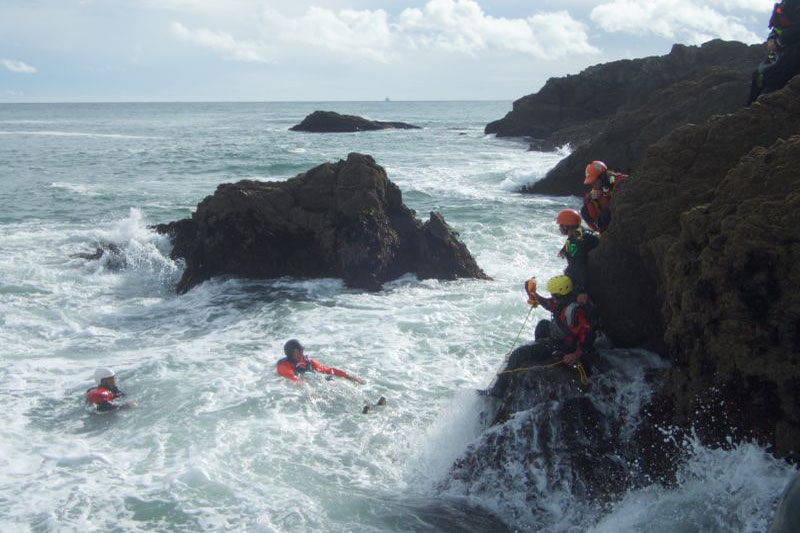
Scenarios – Candidates should be able to deal with a wide variety of scenarios. During this four day course, day 1 & 2 will deal with developing the logical thought process, the understanding of emotional influences on the group during a crisis and getting the basics right. Day three and four are environmental modules, which are interchangeable, these are the ‘Rock Garden Safety & Rescue’ and the ‘Surf Zone Safety & Rescue’.
Candidates should be able to deal with a variety of incidents on the sea and understand the importance of training. Incidents to include, lost equipment, damaged Kayaks,(lost hatches, holed kayaks), damaged Paddlers (dislocated shoulder, unconscious person, hyperthermia, spinal injury, heart attack). Panicked and trapped paddlers, hostile followership, lost and separated paddlers, multiple incidents.
Leadership
This module provides experienced sea kayakers with the essential skills and knowledge to lead effectively in remote marine environments. Participants will explore key leadership theories, decision making, group management, and risk assessment through a combination of classroom learning and practical, on water exercises. Emphasizing safety and communication, the course also covers strategies for managing group dynamics, addressing challenges, and maintaining cohesion in diverse conditions. Upon completion, participants will be better prepared to guide sea kayaking expeditions, ensuring well being and safety of their groups in challenging environments.
Expedition Skills
Customer service and group management skills: Leaders should have the ability to lead a variety of personalities and make every effort to encourage all members of an expedition to achieve the aims and objectives initiated in the planning stage to paddle with a positive outcome.
Create and maintain shelter, rescue strategies
Using a variety of techniques, candidates should be able to construct emergency shelter. These skills may have to be utilised in the event of damaged tents or lost equipment. Leaders may use either a tarp or other natural materials, and to understand how best to seek protection from the elements.Rescue: Guides must have a working knowledge of rescue techniques as well as having in place an emergency action plan.
Fire-skills
Candidates should be able to demonstrate that they can light a fire using a variety of methods and in a variety of conditions including wind and rain. Demonstrate a suitable ‘Leave No Trace’ dismantling of fire and camp sites
Hygiene
Guides should be able to prepare food that has been foraged from the coastal environment in a hygienic manner and should have the appropriate food hygiene qualification, relevant to their home nation and the laws that govern the area of operations.
Packing a kayak, group equipment
The guide must be able to demonstrate effective loading of a sea kayak to other group members, demonstrating trim for effective kayak handling and a suitable itinerary for individual and group members on a multi day expedition.
Camp selection
An understanding of a suitable camp selection should be demonstrated. Camp locations must take into account the prevailing weather conditions as well as size, shelter, risk management, impact, local laws and group requirements.
Trip planning, single day & multi day
The guide will have the ability to plan multi-day expeditions to allow for individual needs and desires within the group. The guide needs to show that they can utilise environmental factors to achieve expedition goals and they can organise resupply strategies and put in place emergency action plans to facilitate casualty and group evacuations.
Equipment
As well as personal equipment the guide must be able to provide and arrange group equipment for a client based expedition including spare food and emergency shelter.
Provisioning and foraging
The candidate should have a basic knowledge of wild foods that are available along a journey to supplement provisions and a safe method for acquiring potable water. The guide should be familiar with the food sources that are available in the areas they are operating in and be able to provide adequate nutrition in the event of an emergency to sustain energy levels within the group until they can implement their emergency action plan.
Wild life & ecology
A good level of knowledge of geological history and a knowledge of the different animal species which are encountered in the areas of operating should be demonstrated.In the event of an emergency an effective individual and group rescue plan can be initiated quickly and effectively. Guides must adhere to an established wildlife code, which shows consideration towards the environment and wildlife interaction, minimising disturbance yet still satisfying clients that they too have a right to co-exist in the natural environmen
Method of Instruction
The ISKGA Method of Instruction Module provides a structured approach to coaching and teaching a wide range of skills to expedition members and sea kayak guides. It covers diverse instructional techniques, enabling guides to improve group abilities or create programs for teaching foundational skills to beginners.The goal is to equip guides with the tools to introduce and up-skill participants in various area, though it is not specifically focused on kayak coaching. This module ensures that proficient sea kayakers can proficiently pass on paddling related skills. Guides must demonstrate a high level of competence in the subject matter before teaching others,
Navigation
This course prepares you for challenging sea journeys, including open water crossings in areas with strong tidal movements exceeding 3 knots. Its aims to equip guides with the skills necessary for effective planning and navigation in advanced sea conditions. The primary objective is to enhance the guides knowledge, awareness, and seamanship. Participants will learn to use nautical charts, maps, pilot books, IALA buoyage, collision regulations, tide tables, and tidal stream atlases. The course will cover how to interpret weather systems, calculate vectors for navigating open crossings, tide races, and over falls, and develop advanced pilotage techniques for poor visibility and night navigation. Additionally, the course will explore oceanography and meteorology to provide a comprehensive understanding of the marine environment.
Sponsors





Local Partners